Pressure-Mounted vs Hardware-Mounted vs Retractable Baby Gates
For a brand building a baby gate range, choosing a product starts with the installation method, the way the barrier opens, and the job each model will do in the range. A different finish alone may not give buyers a clear reason to choose one product over another.
The first distinction is important: pressure-mounted and hardware-mounted describe installation; retractable describes the barrier structure and opening action. These labels overlap. Jinlang’s BG-10, for example, is a retractable mesh gate installed with hardware-mounted brackets.
This guide compares three product directions using BG-01, BG-07 and BG-10 as examples. It is written for brand owners, importers and retail buyers planning a range, sample review or OEM brief.
1. Compare installation and structure separately
A useful product brief answers two questions: how does the gate attach to the opening, and what moves when the user opens it?
| Product direction | Installation and opening structure | What to review on the sample |
|---|---|---|
| Pressure-mounted walk-through gate | An outer frame is secured by pressure adjusters; an inner panel swings open | Mounting components, opening action, passage width and the bottom frame |
| Hardware-mounted swing gate | Hinge and latch components attach to the mounting surfaces; the panel swings open | Brackets, fasteners, swing clearance and passage geometry |
| Hardware-mounted retractable mesh gate | A mesh barrier extends between mounted components and rolls back when opened | Bracket placement, mesh travel, locking sequence and retraction |
Use the full description in quotations, packaging briefs and product comparisons. “Retractable” should not be used as a synonym for “no-drill.” Likewise, the presence of pressure adjusters does not establish which accessories or fixing steps are required in every application. Build installation claims from the selected model’s instructions.
2. Pressure-mounted platforms: differentiate the daily opening experience
Within a pressure-mounted range, the opening action can give two similar-looking gates different roles. Ask whether users must lift the door panel, how the lock operates, and how the passage feels during repeated use.
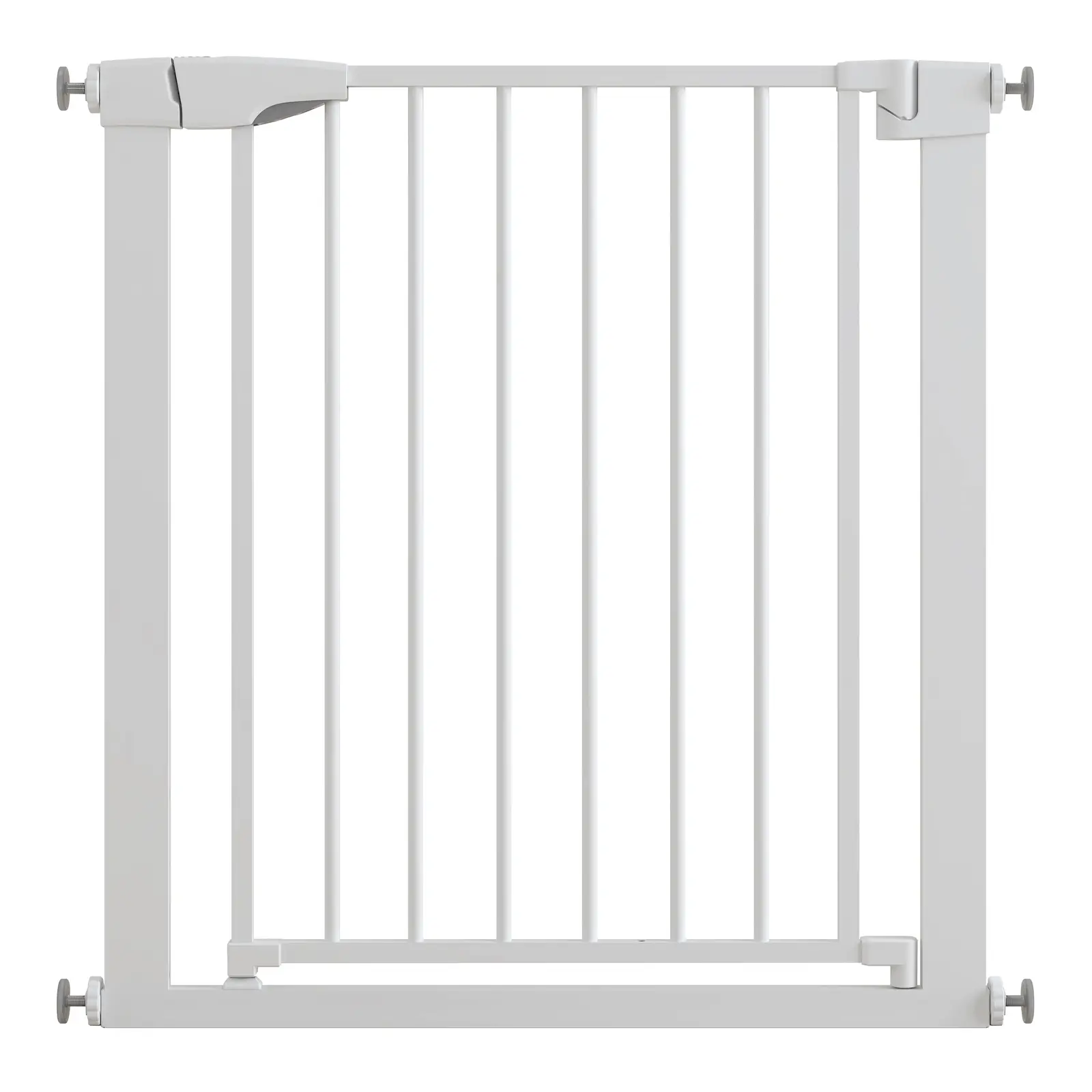
BG-01 is a steel pressure-mounted platform with a no-lift double-lock handle. Its listed base installation range is 75–82 cm. White and wood-grain finishes are presented as options on the same platform.
For a brand, this creates a specific product story: a no-lift opening action combined with a choice of finish. Demonstrate that action on the approved sample and in product videos, rather than relying only on a closed-gate photograph.
When selecting extensions, distinguish the total installation range from the clear walk-through opening. Ask for the approved combinations, accessory list and packing arrangement for each SKU. Do not assume adding extensions changes the width of the swinging door itself.
For range planning, compare models on a short list of visible differences: opening action, threshold design, passage, finish and accessory options. That gives buyers a clearer choice than several listings described only as “strong metal baby gates.”
3. Hardware-mounted swing gates: examine the passage and mounting kit
A hardware-mounted swing platform introduces a different installation and passage arrangement. Review the complete system: panel, hinges, latch, mounting brackets and supplied fasteners.
BG-07 provides an example of an adjustable steel swing gate with a threshold-free passage. Its current commercial configuration lists a 72–105 cm installation range and an adjustable 67–102 cm passage.
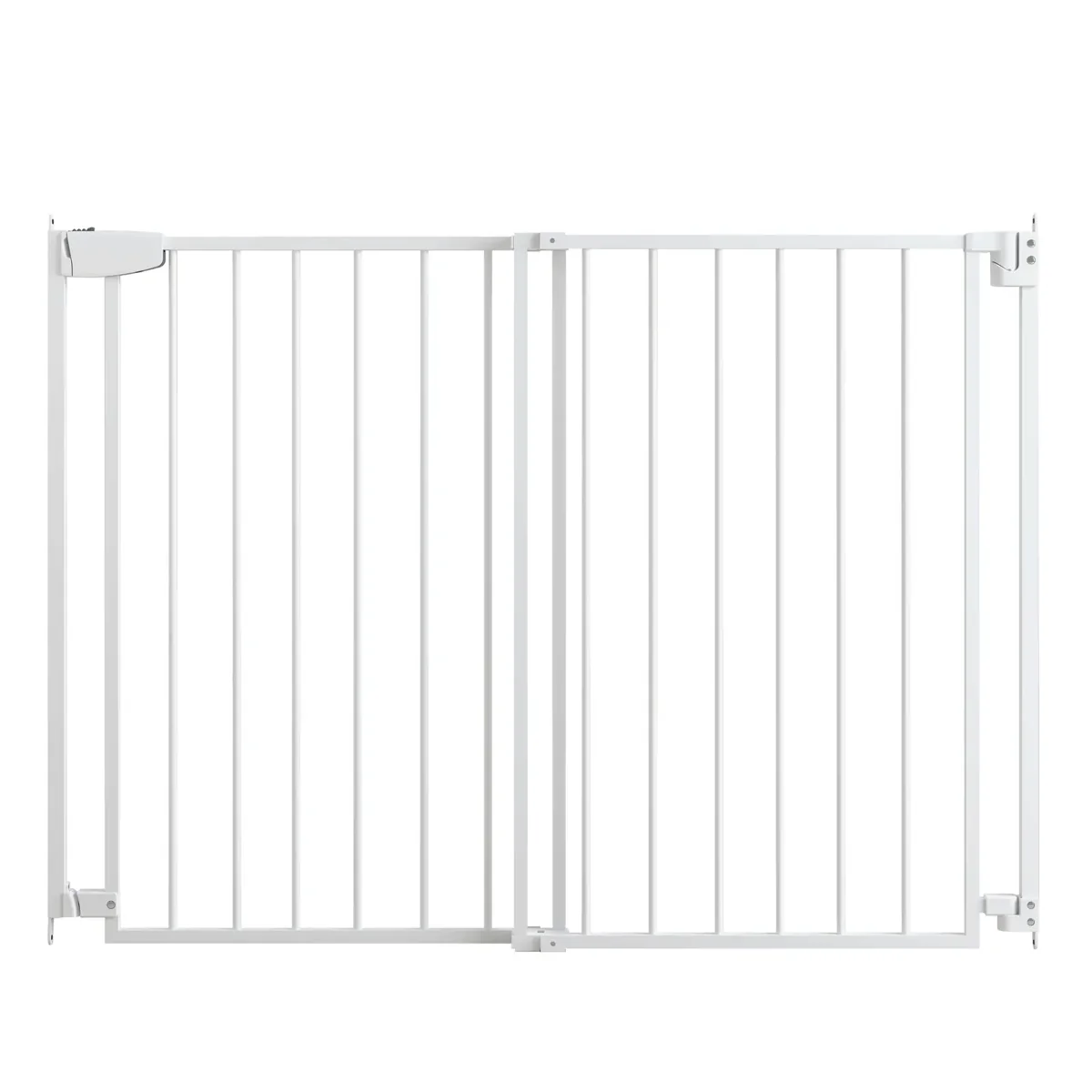
For a retail program, make the meaning of those dimensions clear. Installation range describes the opening the system is intended to fit; passage width describes the space available for moving through the gate. They are different measurements and should not be interchanged in artwork.
Sample review should cover how the panel swings, where the latch engages, and how the mounting hardware and instructions work together. Request clear photographs of the brackets and included parts for your product page and manual brief.
For stair-related positioning, have the exact model, installation location, mounting surfaces and intended claims reviewed against the product instructions and supporting documentation. A broad installation category is not enough to approve that application.
4. Retractable mesh gates: show the complete operating sequence
A retractable platform changes what happens to the barrier when it is opened. Instead of a rigid panel swinging through an arc, the mesh extends across the opening and rolls back beside it.
BG-10 is a hardware-mounted retractable mesh platform, with listed widths of 150, 180 and 200 cm and a listed height of 86 cm. Its mounting arrangement remains part of the product specification; the retracting mesh does not make it a pressure-mounted product.
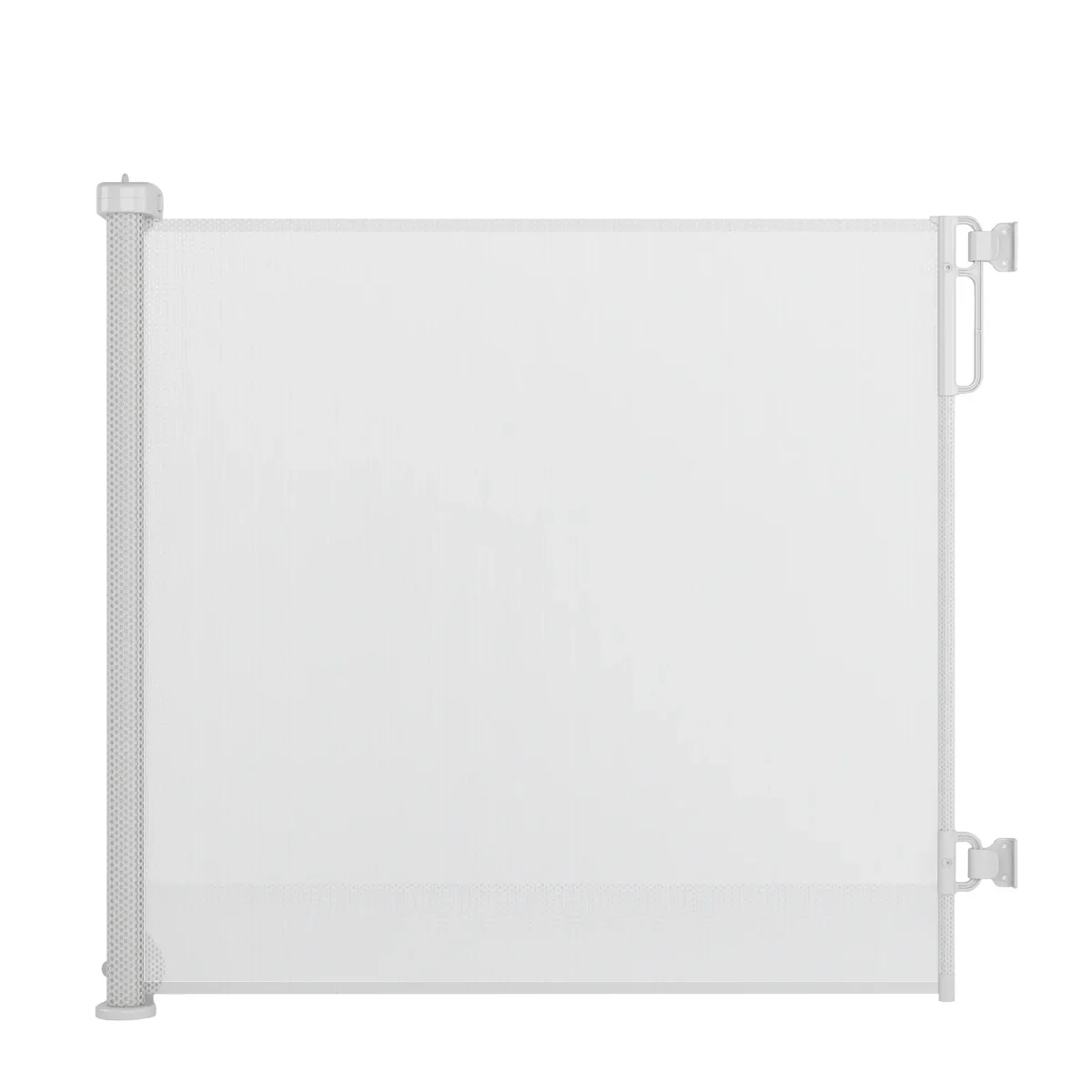
A useful demonstration shows the full sequence: extending the mesh, engaging the latch, operating the controls, releasing the barrier and allowing it to retract. Use the selected sample to confirm the sequence before producing instructions or advertising creative.
For width planning, ask how the listed dimension relates to the required clear opening and the space occupied by the mounted components. Send the mounting-surface details with the measurement. A width on a product sheet should not replace an installation review.
If your range includes more than one retractable model, document the actual differences in controls, brackets, dimensions or mesh specification. Give each model its own accurate photographs and explanation so buyers can understand the reason for separate SKUs.
5. Give each product a clear role in the range
The range does not need an equal number of models in every category. Start with the needs of your customers and assign a distinct purpose to each proposed product.
| Range objective | A product direction to evaluate |
|---|---|
| A metal walk-through option with a different opening action | A no-lift pressure-mounted platform such as BG-01 |
| A swing passage without a bottom frame across the opening | A threshold-free hardware-mounted platform such as BG-07 |
| A barrier that rolls back beside the opening when released | A hardware-mounted retractable mesh platform such as BG-10 |
These are starting points for sample selection. They are not a ranking of safety or a universal recommendation for every location. Approve the final product, installation and documentation for the actual program.
For the commercial side of the project, use our private label guide to MOQ, samples and lead times. It explains how to turn a product shortlist into a clearer quotation and approval plan.
6. Review the same evidence across your shortlisted models
Use a consistent review sheet so the team compares more than appearance or unit price:
- Fit: installation range, clear passage, height and approved accessories.
- Operation: opening and closing sequence, controls and clearance required.
- Installation kit: brackets, fixings, mounting requirements and instructions.
- Brand presentation: finishes, labels, demonstration images and packaging.
- Documentation: relevant existing reports and the testing required for the chosen product and market.
- Order plan: quantity by configuration, sample approval points and shipment requirements.
Jinlang provides relevant existing test documents and coordinates additional third-party testing for the product program. Share your destination market and buyer requirements with the selected model so the team can prepare the documentation plan. See Quality and Compliance for the available resources.
7. Build your product shortlist with Jinlang
Send your target market, intended sales channel, opening dimensions and the product differences you want customers to notice. Include reference images and estimated quantities if you have them.
Jinlang will review the brief and recommend relevant platforms for sample evaluation. Where the project needs a different structure or configuration, our OEM and ODM process provides a route for engineering review and development.
Discuss your baby gate range or email sales@jinlangbabygate.com.